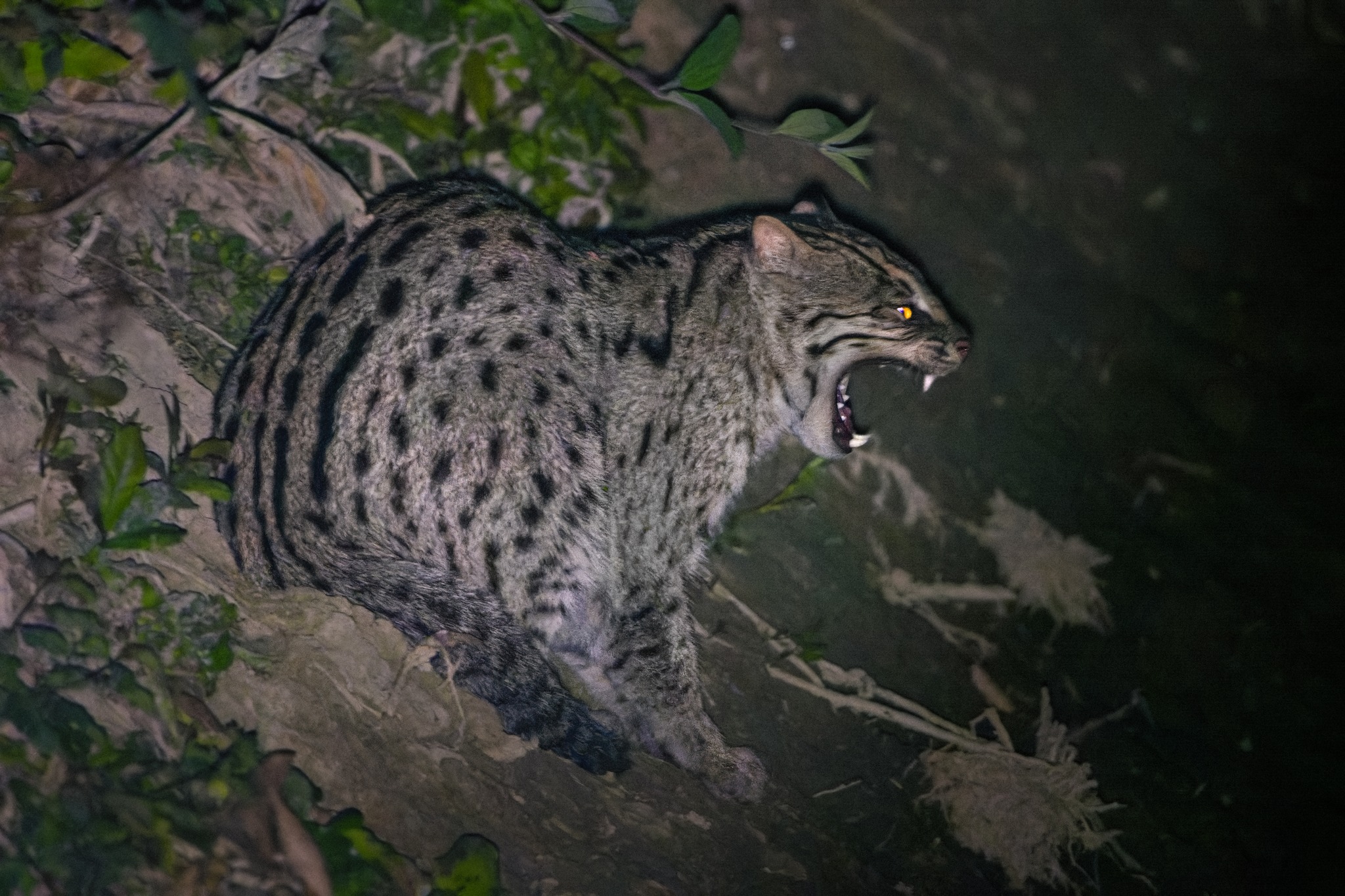
A Silent Night, A Pair of Glowing Eyes
Despite local warnings about ghosts and spirits haunting the remote village edges, I found myself wandering alone in the dead of night one hand holding a torch, the other gripping my camera. The place was silent, wrapped in mist, not a soul in sight.
I quietly moved through a mango grove, and as my torchlight sliced through the dense fog over a mustard field, something caught my eye, two glowing dots in the distance. At first, I assumed it was a fox. But those eyes… they were too familiar. I had seen them before. Last year, deep in the Gajari forest.
They belonged to a Fishing Cat.
Every time I turned my torch on and off, I noticed it was slowly creeping closer, curious but cautious. It felt like a game of hide and seek; I moved, it moved. Sometimes I outwitted it, and other times it vanished like a shadow.
Then, silence.
Suddenly, I heard it call –
Mauw… mauw… mauw…
Right behind me.
I turned around, and there it was again. Its glowing eyes pierced through the fog. For a moment, it tried to intimidate me with a piercing stare. I steadied my left hand with the torch, raised my camera, and clicked the shutter — capturing a rare moment of magic in the wild
What Is a Fishing Cat?
The Fishing Cat (Prionailurus viverrinus) — locally known as মেছো বাঘ — is a medium-sized wild feline native to South and Southeast Asia. Despite the name, it’s not a tiger, though it gets its Bengali name from its striped legs and spotted body, which vaguely resemble a tiger cub.
True to its name, this remarkable predator is a skilled swimmer and primarily feeds on fish, frogs, crustaceans, and occasionally small mammals and birds.
Habitat and Behavior
Fishing Cats are strongly associated with wetland ecosystems:
- Preferred habitats: marshes, reed beds, mangrove swamps, flooded forests, oxbow lakes, and paddy fields.
- Nocturnal nature: They are mostly active at night and extremely elusive, making encounters like mine truly rare.
- Excellent swimmers: Their partially webbed feet allow them to swim long distances, even diving to catch prey underwater.
In Bangladesh, they are primarily found in:
- The Sundarbans
- Sylhet’s haor areas
- Chalan Beel
- Coastal and wetland zones of Khulna, Bagerhat, and Satkhira
- Occasionally in agricultural fields and village edges where water bodies are nearby
IUCN Status: Endangered in Bangladesh
Globally, the Fishing Cat is listed as “Vulnerable” on the IUCN Red List, but in Bangladesh, its status is “Endangered” due to rapidly declining populations.
Why Are They Threatened?
Fishing Cats are wetland specialists, which means their survival depends heavily on the health of marshlands, rivers, and water bodies — all of which are under severe threat in Bangladesh.
Major threats include:
- Wetland destruction: Rapid urbanization, industrial expansion, and drainage of wetlands for agriculture and settlements
- Human-wildlife conflict: Locals often kill them mistaking them for threats to livestock or poultry
- Road kills: Many dies while crossing roads near wetland zones
- Poaching and trapping: Though illegal, it still occurs
- Lack of awareness: Most villagers do not know that the Fishing Cat is a protected species under Bangladesh law
Conservation: Why This Matters
The Fishing Cat is not just a symbol of wild wetlands — it’s an indicator species. Its presence signals a healthy ecosystem.
If we lose them, we also lose the health of our wetlands, which are crucial for flood protection, water filtration, and biodiversity.
Thankfully, local conservationists and wildlife organizations have started awareness programs, community engagement, and habitat restoration projects. But much more needs to be done — and quickly.
Did You Know?
- Fishing Cats chirp and growl rather than roar or meow.
- Their feet are partially webbed — a rare trait among felines.
- They can swim up to 2 kilometers in search of food.
- They sometimes dive underwater to catch fish — like a small, whiskered otter!